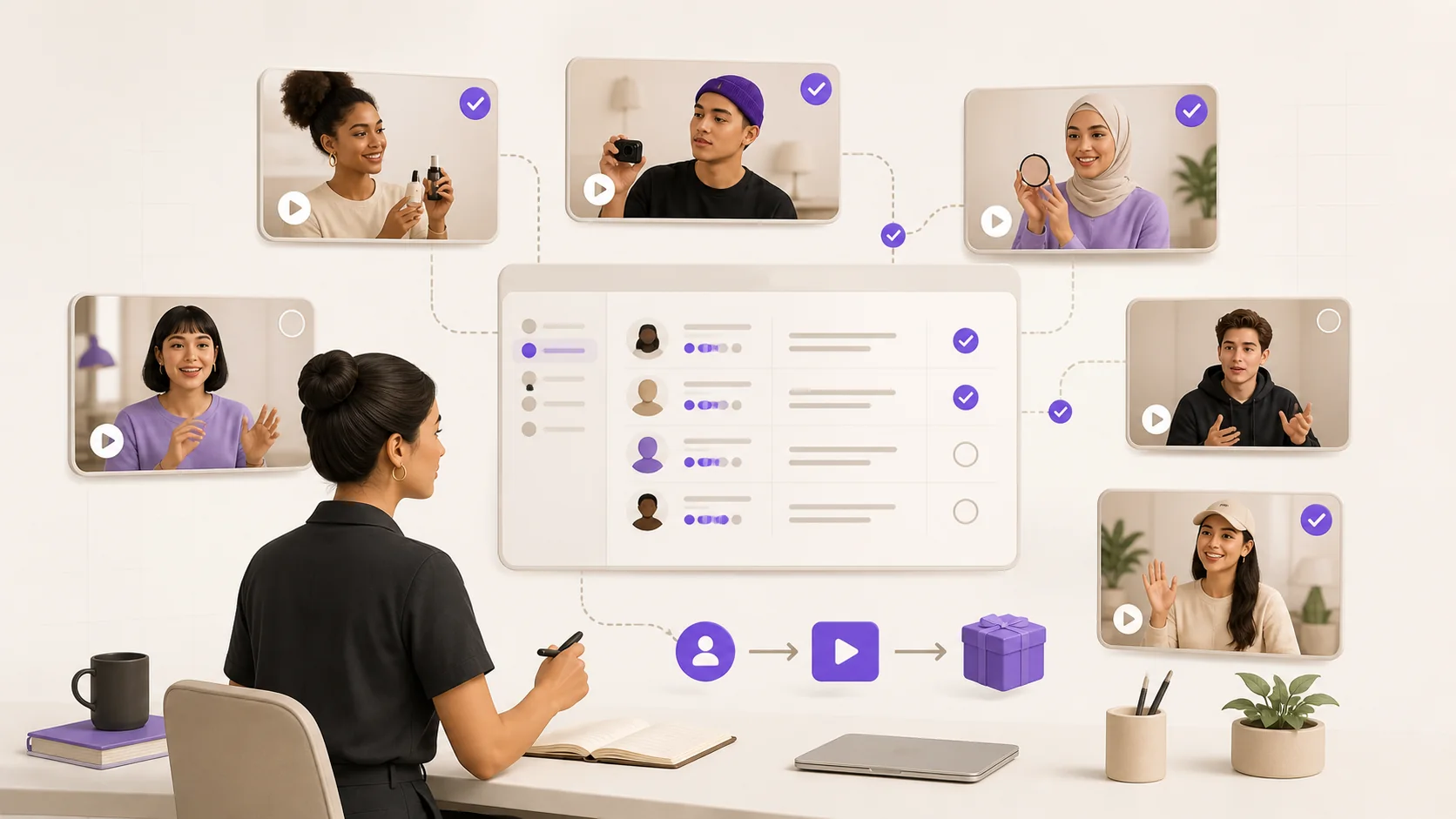
Quick comparison: best micro influencer platforms by use case
Key Takeaways
Choosing the right micro influencer platform in 2026 requires understanding the gap between discovery tools and full operational systems. Here's what matters most when evaluating platforms for your creator programs:
- Platform costs are just the beginning: Self-serve tools start at $199-$999/month, but creator payments, usage rights (adding 20-50%), shipping, and 1099 tax forms typically double your initial budget estimates.
- Workflow automation beats database size: A platform with 1 million verified creators outperforms one with 12 million unvetted profiles. Look for fake follower detection, automated approvals, and centralized payment systems rather than raw creator counts.
- Scale determines your platform type: Managing 10 creators works with manual coordination and discovery tools. Scaling to 100+ creators demands workflow automation for contracts, content approvals, and batch payments—or managed services starting at $10,000+ monthly.
- Micro influencers deliver superior ROI: With 3-10% engagement rates versus 1-3% for macro influencers, micro creators (10K-100K followers) convert 25% better and cost 10-20x less, letting you diversify risk across multiple partnerships.
- Usage rights pricing varies dramatically: The same 30-second video costs $50 to $2,000+ depending on distribution terms. Social media organic usage adds 15-25% to base rates, while paid amplification adds 25-40%, and perpetual rights double costs.
Before committing to any platform, ask how many creators posted in your niche within 60 days, what fraud detection methods they use, whether approval workflows exist in-platform, and if pricing remains fixed at renewal. The right choice depends on whether your bottleneck is finding creators or executing campaigns at scale.
Micro influencer platforms face a pricing problem in 2026. The same 30-second video can cost anywhere from $50 to $2,000+ depending on the creator, usage rights, and distribution terms
. Influencer marketing became the largest advertising channel with $266.92B in expected spend by end of 2025
. Teams need to find creators faster, manage campaigns at scale, and track performance without inflating costs
. This piece compares top micro influencer platforms on pricing models and workflow automation, plus whether they suit discovery needs or full
operations.
What is a Micro Influencer and Why Platform Choice Matters
Micro Influencer Definition and Follower Range
A micro influencer is a content creator with 10,000 to 100,000 followers who maintains a niche audience that's involved. Most influencer marketing platforms use this standard definition, though platform-specific thresholds vary. Instagram micro influencers fall within the 10,000 to 100,000 range and represent the dominant category. They host 68% of active influencer partnerships according to 2026 data. TikTok micro influencers operate at a lower threshold of 5,000 to 50,000 followers because of the platform's viral algorithm. A 20,000-follower TikTok account may carry more weight than 50,000 Instagram followers. YouTube micro influencers mirror the Instagram standard at 10,000 to 100,000 subscribers. LinkedIn micro influencers range from 5,000 to 25,000 followers.
The engagement gap separates micro influencers from larger accounts. Micro influencers achieve 3% to 10% engagement rates, while macro influencers deliver 1% to 3%. Research shows micro influencers convert 25% better than macro influencers. 77% of brands now prefer working with them over larger creators. A brand can partner with 10 to 20 micro influencers for the same budget as a single macro influencer post. This broadens audience reach and reduces risk.
Three Platform Types: Self-Serve, Managed, and Hybrid
Self-serve platforms provide software tools to run campaigns on your own. These platforms charge flat monthly fees, such as $79 per month. Brands get the creator database, outreach tools and campaign dashboards. Self-serve works best for teams with in-house bandwidth to manage creator sourcing, contract negotiation, content approval and performance tracking. The speed advantage matters. Self-serve platforms let brands begin campaigns in minutes with no onboarding calls. Managed services need briefing sessions and back-and-forth with account managers before launch.
Managed services run campaigns from start to finish. A dedicated team handles strategy development, creator vetting, contract execution, content oversight and reporting. Managed partners charge per campaign, as a percentage of spend, or via agency retainer fees. Full-service agencies offer strategic planning that lines up with brand goals. They provide expert-curated talent sourcing and creative oversight led by directors. Account teams handle relationship management. The trade-off sits between control and time. Managed services cost more but eliminate the need for internal headcount dedicated to influencer operations.
Hybrid models blend software access with selective services. Brands operate within a platform but receive strategic support, such as influencer audits, content approval assistance or legal contract review. Hybrid partners handle specific bottlenecks without taking over the entire campaign. This model suits teams that just need co-pilots rather than full delegation.
Discovery Tools That Fall Short
Most influencer discovery tools assist with finding creators instead of automating the full workflow. This leaves room for poor matches and underwhelming collaborations. A discovery tool that surfaces 50 creator profiles through database search solves the identification problem but stops there. Brands still face outreach, negotiation, brief creation, content approval, usage rights management, payment processing and 1099 tax form distribution.
The operational gap widens at scale. Working with 10 creators needs manual coordination. Working with 100 creators demands workflow automation, standardized contracts, batch payment systems and content libraries. Discovery tools work when the bottleneck is finding creators. Managed or hybrid platforms become a must when the bottleneck changes to executing campaigns without adding full-time staff.
How We Evaluated Micro Influencer Platforms
Evaluation criteria determine whether a platform matches operational needs or creates new bottlenecks. The assessment framework focused on five core areas that separate platforms with surface-level features from those built for repeatable micro influencer programs at scale.
Creator Network Size and Verification Standards
Verification rigor matters more than network size. Platforms advertising 1.2 million creators often include dormant accounts, bot-inflated profiles, and creators who never respond to outreach. Verification standards separate usable networks from inflated databases.
Fake follower detection starts with engagement rate calculation. Total engagements (likes and comments) should be divided by follower count, then multiplied by 100. Very low engagement rates signal fake follower accounts. Artificially high rates suggest automated bots or purchased engagement. Suspicious comment patterns include emoji-only responses and short repetitive phrases. Accounts where following count equals or exceeds follower count raise additional red flags.
Audience fit requires scanning comments for language, intent, and recurring questions. Audiences that ask for links and purchasing information signal strong commerce intent. Content fit analysis examines five recent brand integrations to assess whether placements feel natural or forced. Consistency checks focus on posting cadence and format stability, as sporadic creators prove difficult to schedule around product launches. Performance stability compares median views to recent spikes, since one viral post can distort average metrics.
Speed to Launch and Workflow Automation
Campaign launch speed separates self-serve tools from managed bottlenecks. Self-serve platforms enable campaign initiation within minutes. Managed services require briefing sessions and account manager coordination before launch. Workflow automation reduces the manual tasks that previously filled team calendars.
Centralized approval systems keep drafts and feedback in one shared workspace instead of scattered in email, Slack, and direct messages. One consolidated feedback pass per round prevents revision cycles from extending indefinitely. Approval ownership by category streamlines decision-making when tone reviews, legal claims verification, and visual restriction checks require different stakeholders.
Pricing Transparency and Contract Terms
Usage rights pricing varies substantially between platforms. Social media organic usage for six months adds 15 to 25% to base creator rates. Social media paid amplification adds 25 to 40%. Print and broadcast usage increase costs by 50 to 100%. Perpetual worldwide rights add 50 to 100% above a standard 12-month license.
Whitelisting operates as a separate media product with distinct fees and written approval requirements for ad captions and targeting parameters. Exclusivity clauses specify competitor categories and duration windows (30 to 90 days for campaign content). They also define whether restrictions apply to direct competitors only or entire verticals. Kill fee benchmarks range from 25 to 50% of total fees when cancelation occurs after brief delivery but before production. They increase to 50 to 75% after production starts and reach 100% when content is delivered and approved but not published. Standard contracts include two revision rounds, with additional rounds priced at 15 to 20% of base fees.
Content Approval and Brand Safety Controls
FTC compliance requires clear disclosure placement. Sponsored content must include #ad or #sponsored labels before caption fold points, with verbal disclosures at video starts. Content review processes involve multiple stakeholders including marketing teams, legal advisers, and brand managers. Structured timelines with defined approval criteria prevent delays while maintaining quality standards.
Analytics, Attribution, and Reporting Depth
Attribution models determine how platforms assign credit for conversions. First-touch attribution credits initial discovery interactions and reveals which creators excel at awareness generation. Last-touch attribution assigns credit to final touchpoints before purchase and highlights conversion-focused creators. Multi-touch attribution distributes credit over multiple customer journey interactions and reflects that conversions rarely result from single exposures.
Tracking methods include UTM parameters added to URLs for source identification and promo codes that connect purchases to specific campaigns when click tracking fails. Ecommerce platform integrations with Shopify, WooCommerce, and Amazon provide direct sales attribution. Platforms that combine campaign results into custom dashboards displaying revenue, ROI, average order value, and commission calculations enable analytical budget allocation decisions.
Top Micro Influencer Platforms Compared
Six platforms dominate the micro influencer marketing landscape. Each platform is built around different operational models and creator networks.
Launchpoint: Managed Operations with College Athletes
Launchpoint operates as a mobile-first platform connecting brands with college athlete influencers for Name, Image, and Likeness (NIL) marketing campaigns. Ohio State University football safety Caleb Downs co-founded the platform alongside Cornell University graduates Tristan Rhee and Adam Barr-Neuwirth. The platform launched in August 2024. The company focused on Ohio State athletes at first before expanding to major universities like Florida, Georgia, Texas, and USC.
The platform handles campaign lifecycle management through AI-powered auto-screening for brand safety, auto-creation of video outlines, and access to verified college athletes. Communications, payouts via Venmo and PayPal, and tax compliance operate through the app. This creates minimal operational burden for brands. Revenue generation follows two streams: commissions on deals and subscription fees for brands. Athletes use the platform without charges. Launchpoint distinguishes itself through performance-based creator payments tied to view counts rather than flat fees.
SideShift: Gen Z Creator Marketplace
SideShift functions as a creator marketplace where brands post campaign briefs and receive applications from a network exceeding 1 million U.S.-based creators. The workflow mirrors job board mechanics. Brands publish requirements, review applications, select creators, and coordinate through direct messaging. Automated screening and scheduling process every applicant within 24 hours.
Pricing starts at $199 per month for one job listing with capacity to hire one to five creators. Growth accounts cost $299 monthly for two listings and five to 15 hires. Scale plans run $999 monthly for three listings and unlimited hiring. Managed enterprise services begin at $10,000 per month. The platform reports that 90% of roles fill within three days. Performance tracking displays views, engagement, and conversions per creator through a unified dashboard. SideShift has made over $100 million in creator payouts easier.
Upfluence: All-in-One with Affiliate Tracking
Upfluence operates as a complete influencer marketing platform with deep ecommerce integration across Shopify, WooCommerce, and Amazon. The platform connects creators to product catalogs and attributes sales to each creator. It tracks clicks, conversions, and ROI per partnership. Subscription pricing starts at $478 monthly.
The Creator Marketplace provides access to 12 million performance-verified creators powered by Jaice AI. Discovery operates through 20+ advanced search filters like keywords, location, platform, and follower count. Upfluence supports Instagram, YouTube, Twitter, Pinterest, Twitch, and TikTok. The affiliate management system operates commission-free. Brands can run creator programs without platform fees on sales. Upfluence Pay supports creator payouts in 120+ countries while maintaining payment status, documentation, and commission records within campaign workflows.
GRIN: Creator CRM and Content Library
GRIN positions as an AI-operated creator marketing platform where Gia, the AI agent, handles program operations end-to-end. The platform operates on creator CRM foundations with 10+ years of creator marketing performance data. GRIN provides access to 190 million creator profiles through web scraping and public data aggregation.
The GRIN Marketplace connects brands to 700,000+ active creators through a free app. Gia automates discovery, outreach drafting, application handling, onboarding, and gifting workflows. The free tier has unlimited creators, links, and codes with no credit card required for simple affiliate programs. Commission-free affiliate programs mean brands pay only when Gia performs high-value work like managing partnerships or building custom reports. Enterprise pricing ranges from $30,000 to $200,000+ annually in most cases.
Modash: Ecommerce-Focused with Shopify Integration
Modash blends directly with Shopify to track sales, orders, discounts, and product data in unified dashboards. The platform enables product gifting through one-time codes where creators select items and place orders themselves. Affiliate programs support flexible commission tiers with percentage or fixed rates for new versus returning customers.
Pricing begins at $299 monthly for the Essentials plan. This has two team members, 300 profile analyzes, 150 email unlocks, and tracking for 100 influencers. The Performance plan costs $599 monthly with five team members, 800 profile analyzes, and 400 email unlocks. Modash provides discovery across 350 million creators on Instagram, TikTok, and YouTube.
inBeat Agency: White-Glove UGC Production
inBeat operates as a performance-focused UGC agency rather than self-serve software. The team handles creative brief development, creator sourcing, script writing, and production management across multiple content variations. Services span Instagram Reels and Stories, TikTok content, YouTube Shorts, and paid social creative. The agency tracks performance by creator, hook, and concept. It eliminates underperforming assets while scaling successful content. UGC production focuses on scroll-stopping Meta ad creative built to improve ROAS across Feed, Reels, and Stories.
Pricing Models and What You Actually Pay
Platform fees represent only one portion of total program costs. Creator payments and operational overhead double original budget estimates in most cases.
Self-Serve Subscription Pricing ($199-$999/month)
Self-serve subscription models publish transparent pricing tiers with defined limits. Modash Essentials starts at $199 monthly on annual billing and includes two seats, 300 profile views, 150 email unlocks, and 100 tracked creators. Performance plans cost $499 monthly with expanded caps. Dash Social begins at $999 monthly with Creator Management sold as a separate add-on.
GRIN operates on usage-based credits rather than seat licensing. The Starter plan costs $200 monthly for 2,000 Gia credits. Plans scale to $1,500 monthly for Complete tier access. Upfluence requires custom quotes with no published checkout pricing. InfluenceKit charges $99 per influencer on the Flex plan, while Unlimited runs $399 monthly.
Managed Service Fees and Minimums
Agency retainers range from $3,000 to $25,000 monthly depending on campaign scale. A $5,000 retainer covers three to five mid-tier creators monthly. A $15,000 retainer supports 10 to 20 creator programs. Agencies add 15 to 30% markup on creator fees on top of retainers. A creator charging $5,000 per post may appear on invoices at $6,000 to $6,250. Agencies keep the difference.
Usage-Based Pricing vs Fixed Contracts
Usage-based models charge for consumption rather than flat access fees. Seventy-four percent of software suppliers adopted usage-based models as of 2026. Fifty-six percent expect usage revenue growth by 2027. Fixed subscription billing provides predictable recurring revenue but creates churn when customers underuse products relative to their spend.
Hidden Costs: Creator Payments, Shipping, 1099s
Creator fees operate separately from platform subscriptions. Micro influencers charge $100 to $500 per post, while macro creators demand thousands per post. Brands must issue 1099-NEC forms to influencers earning over $600 from one client. Usage rights add 20 to 50% above base influencer fees when brands repurpose content as paid ads. Product gifting and shipping add another 50 to 100% to stated platform costs.
Core Workflow Elements That Separate Platforms
Workflow automation determines whether teams spend hours coordinating or minutes launching campaigns. The operational differences between micro influencer platforms emerge most clearly in six workflow stages.
Creator Sourcing: Database Search vs Self-Selection
Database search requires brands to filter creator profiles, send outreach messages and negotiate individually. Application-based models reverse this dynamic. Brands post campaign briefs to marketplaces. Creators self-select into opportunities that match their audience and content style. Self-selection delivers higher fit rates since participating creators already want the partnership.
Brief Creation and Campaign Setup
Campaign briefs separate into public summaries and full creative directions. Public summaries appear during creator applications and cover content format, compensation and timelines without revealing proprietary strategy. Full briefs unlock after acceptance and contain messaging scripts, visual concepts and submission guidelines. Template systems populate default structures covering brand background, concept description, must-hit messaging points and inspiration references.
Content Review and Approval Workflows
Approval processes define revision expectations before production starts. One to two revision rounds suit most campaigns when brands provide clear guidelines. Pre-approval workflows require creators to submit concept write-ups and shooting locations before filming. This prevents reshoots that can get pricey. Multiple stakeholders can unite their feedback into single documents, which reduces back-and-forth cycles.
Usage Rights and Licensing Management
Limited usage grants brands platform-specific rights for defined periods, typically one month. Unlimited usage covers multiple platforms for set durations at 40 to 100% above base rates. Perpetual rights transfer permanent control at 100%+ premiums. Allowlisting is different from usage rights by magnifying existing creator posts rather than repurposing content across brand channels.
Tracking, Payouts and Creator Payments
Payment platforms centralize onboarding, invoicing, tax documentation and fund transfers. PayPal supports 10-currency payouts with automatic conversions. Lumanu uses invoice-based funding for multi-currency corporate disbursements. Brands must issue 1099-NEC forms to creators earning over $600 annually.
Brand Safety and Trust Score Systems
Trust scores total risk signals from content history, audience sentiment, partnership patterns and authenticity indicators. Platforms assign numerical safety ratings based on unsafe content percentages associated with each creator. Vetting workflows review 12 to 24 months of posts for recurring themes, tone changes and visual symbolism carrying cultural meaning.
When You Need UGC Operations vs Influencer Discovery
Decision points between discovery tools and full operations platforms hinge on four factors that reveal capacity gaps before they stall campaigns.
Signs You've Outgrown Database-Only Tools
Most buyers regret their influencer platform choice within six months. Products don't fail. Evaluation skipped questions that reveal mismatches before commitment. Manual export cycles, disconnected tracking in a variety of tools, and scattered creator payment records signal that search functionality alone no longer supports operational needs. Influencer fraud costs brands an estimated $1.30 billion each year, about 15% of spend in a market exceeding $30 billion. Platforms cannot detect that 37% of influencer followers show signs of being fake or purchased. Vetting burdens move to internal teams.
Volume Thresholds: 10 Creators vs 1,000 Creators
Ten creators require coordination. One hundred creators just need automation to handle contracts, approvals, payments and 1099 distribution. You can scale operations without adding headcount. Audit current processes, automate repetitive tasks and redesign workflows.
Managed Operations for Scale Without Headcount
Systems, automation and structured processes enable growth from 10 to 100 creators without operational chaos. Better tools make running 25 to 50 creators monthly sustainable rather than additional employees.
Buyer Checklist: Questions to Ask Before Committing
Ask platforms how many active creators posted in your niche within 60 days and what fake follower detection methods they use. Check whether approval workflows exist inside the platform and if pricing remains fixed at renewal. Compare UGC Infra's campaign workflow with current creator operations. Request a product walkthrough at the time operational gaps exceed discovery needs.
Best micro influencer platforms by use case
The best micro influencer platform depends on the work your team needs to remove. Use this shortlist to match the platform model to the campaign rather than choosing by database size alone.
| Primary use case | Platform to evaluate | Why it fits | Check before buying |
|---|---|---|---|
| Application-led creator sourcing | SideShift | Creators apply to posted briefs, reducing cold outreach | Active creators in your niche, hiring limits, and total campaign fees |
| College athlete and NIL campaigns | Launchpoint | Specialized access to college athletes and managed campaign operations | University coverage, approval flow, rights, and payment terms |
| Ecommerce and affiliate attribution | Upfluence or Modash | Product, code, link, and sales tracking support commerce programs | Integration depth, tracked-creator limits, and payout workflow |
| Enterprise creator relationship management | GRIN | CRM, outreach, gifting, and content-library workflows support larger programs | Annual commitment, implementation needs, and active-network quality |
| Managed UGC ad production | inBeat | A service team handles sourcing and production when internal capacity is limited | Creative ownership, revision policy, usage rights, and reporting detail |
| Post-sourcing UGC operations | UGC Infra | Campaign records connect briefs, approvals, posts, reporting, and payouts | Use a marketplace or agency alongside it when creator discovery is the bottleneck |
If the immediate problem is finding and vetting creators, use the UGC creator sourcing guide. For a broader software shortlist, compare the best UGC platforms for brands.
Micro influencer platform vs UGC operations platform
A micro influencer platform usually emphasizes discovery, audience data, outreach, or creator-posted distribution. A UGC operations platform manages what happens after creators are selected: briefs, submissions, revisions, approvals, usage rights, live-post evidence, reporting, and payouts. Teams buying both content and reach may need both layers. Separating them prevents a large discovery database from being mistaken for an end-to-end campaign workflow.
Comparison Table
Micro Influencer Platform Comparison Table
Platform Overview and Pricing Comparison
| Platform | Platform Type | Starting Price | Creator Network Size | Main Specialization |
| Launchpoint | Managed (Mobile-first) | Not mentioned | College athletes at major universities (Ohio State, Florida, Georgia, Texas, USC) | NIL marketing with college athlete influencers; performance-based payments tied to view counts |
| SideShift | Self-serve Marketplace | $199/month (1 job listing, 1-5 creators) | 1 million+ U.S.-based creators | Gen Z creator marketplace with application-based workflow; 90% of roles fill within 3 days |
| Upfluence | Self-serve (All-in-One) | $478/month | 12 million performance-verified creators | Ecommerce integration (Shopify, WooCommerce, Amazon) with affiliate tracking and sales attribution |
| GRIN | Self-serve (AI-powered) | $200/month (Starter: 2,000 Gia credits) | 190 million creator profiles (via web scraping); 700,000+ active creators in Marketplace | Creator CRM with AI agent (Gia) handling end-to-end operations; commission-free affiliate programs |
| Modash | Self-serve | $299/month (Essentials: annual billing) | 350 million creators (Instagram, TikTok, YouTube) | Shopify integration with direct sales tracking and product gifting via one-time codes |
| inBeat Agency | Managed (Full-service) | Not mentioned | Not mentioned | White-glove UGC production with creative brief development, script writing, and performance tracking |
Detailed Feature Comparison
| Feature | Launchpoint | SideShift | Upfluence | GRIN | Modash | inBeat Agency |
| Workflow Model | AI-powered auto-screening, auto-creation of video outlines | Job board mechanics: brands post briefs, creators apply | Database search with 20+ filters | AI agent (Gia) automates discovery, outreach, applications, onboarding | Database search with profile analysis | Full campaign management from brief to production |
| Payment Methods | Venmo, PayPal (in-app) | Not mentioned | Upfluence Pay (120+ countries) | Not mentioned | Not mentioned | Not mentioned |
| Tax Compliance | Handled through app | Not mentioned | Payment documentation and commission records managed to keep | Not mentioned | Not mentioned | Not mentioned |
| Revenue Model | Commissions on deals + subscription fees for brands (athletes use free) | Monthly subscription tiers | Monthly subscription | Usage-based credits + subscription tiers | Monthly subscription | Agency retainer model |
| Platform Support | Not mentioned | Not mentioned | Instagram, YouTube, Twitter, Pinterest, Twitch, TikTok | Not mentioned | Instagram, TikTok, YouTube | Instagram Reels/Stories, TikTok, YouTube Shorts |
| Ecommerce Integration | Not mentioned | Not mentioned | Shopify, WooCommerce, Amazon with sales attribution | Not mentioned | Shopify with sales, orders, discounts tracking | Not mentioned |
| Content Types | Video content | Not mentioned | Multiple formats | Multiple formats | Multiple formats | Reels, Stories, TikTok, YouTube Shorts, paid social creative |
| Analytics & Tracking | Performance-based view counts | Views, engagement, conversions per creator in unified dashboard | Clicks, conversions, ROI per partnership | Custom reports (requires Gia credits) | Sales, orders, discounts in unified dashboard | Performance by creator, hook, and concept |
Pricing Tier Details
| Platform | Entry Tier | Mid Tier | High Tier | Enterprise |
| SideShift | $199/month (1 listing, 1-5 hires) | $299/month Growth (2 listings, 5-15 hires) | $999/month Scale (3 listings, unlimited hiring) | $10,000+/month (managed services) |
| Upfluence | $478/month | Not mentioned | Not mentioned | Custom quotes |
| GRIN | $200/month (2,000 Gia credits) | Not mentioned | $1,500/month (Complete tier) | $30,000-$200,000+ annually |
| Modash | $299/month Essentials (2 team members, 300 profile analyzes, 150 email unlocks, 100 tracked creators) | $599/month Performance (5 team members, 800 profile analyzes, 400 email unlocks) | Not mentioned | Not mentioned |
| Launchpoint | Not mentioned | Not mentioned | Not mentioned | Not mentioned |
| inBeat Agency | Not mentioned | Not mentioned | Not mentioned | Not mentioned |
Key Operational Features
| Capability | Launchpoint | SideShift | Upfluence | GRIN | Modash | inBeat Agency |
| Brand Safety Controls | AI-powered auto-screening | Automated screening within 24 hours | Not mentioned | Not mentioned | Not mentioned | Not mentioned |
| Affiliate Management | Not mentioned | Not mentioned | Commission-free affiliate system | Commission-free affiliate programs | Flexible commission tiers (percentage or fixed rates) | Not mentioned |
| Product Gifting | Not mentioned | Not mentioned | Not mentioned | Automated gifting workflows | One-time codes for creator self-selection | Not mentioned |
| Team Collaboration | Not mentioned | Not mentioned | Not mentioned | Not mentioned | 2-5 team members (tier-dependent) | Full agency team |
| Launch Speed | Not mentioned | Roles fill within 3 days | Not mentioned | Minutes (self-serve) | Not mentioned | Requires briefing sessions |
| Creator Payouts | Over $100 million aided | Not mentioned | Not mentioned | Not mentioned | Not mentioned | Not mentioned |
Note: This comparison uses information available in this piece as of 2026. Pricing and features are subject to change. You should select platforms based on specific operational needs, team capacity, and campaign scale requirements.
Conclusion
Platform choice depends on operational capacity rather than feature lists. Self-serve tools starting at $199 monthly suit teams with bandwidth to manage outreach and contracts. Managed services handle execution but require $10,000+ monthly commitments. The real cost extends beyond subscriptions: creator fees, usage rights, and tax compliance double initial budgets in most cases. Teams that work with 10 creators can coordinate on their own. Those scaling to 100+ need workflow automation to approve payments and manage content libraries. Brands should compare UGC Infra's campaign workflow with their current creator operations and request a product walkthrough when tools to find creators no longer support execution needs.
FAQs
Q1. What follower count qualifies someone as a micro influencer? A micro influencer typically has between 10,000 to 100,000 followers, though this varies slightly by platform. TikTok micro influencers operate at a lower threshold of 5,000 to 50,000 followers due to the platform's viral algorithm, while LinkedIn micro influencers range from 5,000 to 25,000 followers. What sets micro influencers apart isn't just follower count—they achieve 3% to 10% engagement rates and convert 25% better than macro influencers.
Q2. How much do micro influencer platforms actually cost? Platform subscription fees range from $199 to $999 monthly for self-serve tools, but that's only part of the total cost. Creator payments, usage rights (which add 20-50% to base fees), product shipping, and tax documentation typically double initial budget estimates. Managed services start at $3,000 to $25,000 monthly retainers, with agencies adding 15-30% markup on creator fees. The same 30-second video can cost anywhere from $50 to $2,000+ depending on usage rights and distribution terms.
Q3. What's the difference between self-serve and managed influencer platforms? Self-serve platforms provide software tools for running campaigns independently with flat monthly fees, giving you full control over creator sourcing, outreach, and campaign management. Managed services handle the entire campaign lifecycle—from strategy and creator vetting to content oversight and reporting—but require higher budgets starting at $10,000+ monthly. Hybrid models offer a middle ground, providing software access with selective support for specific bottlenecks like content approval or contract review.
Q4. When should I switch from a discovery tool to a full operations platform? Discovery tools work well when you're managing around 10 creators and your main challenge is finding the right people. Once you scale to 100+ creators, you need workflow automation for contracts, approvals, batch payments, and 1099 distribution. Warning signs include manual export cycles, disconnected tracking across multiple tools, scattered payment records, and spending more time coordinating than creating. At this volume, operational efficiency matters more than database size.
Q5. What usage rights should I negotiate with micro influencers? Usage rights determine how you can repurpose creator content beyond the original post. Limited usage grants platform-specific rights for one month at base rates. Unlimited usage across multiple platforms for set durations adds 40-100% to base fees. Social media organic usage for six months adds 15-25%, while paid amplification adds 25-40%. Print and broadcast usage increase costs by 50-100%, and perpetual worldwide rights add 50-100% above standard 12-month licenses.