
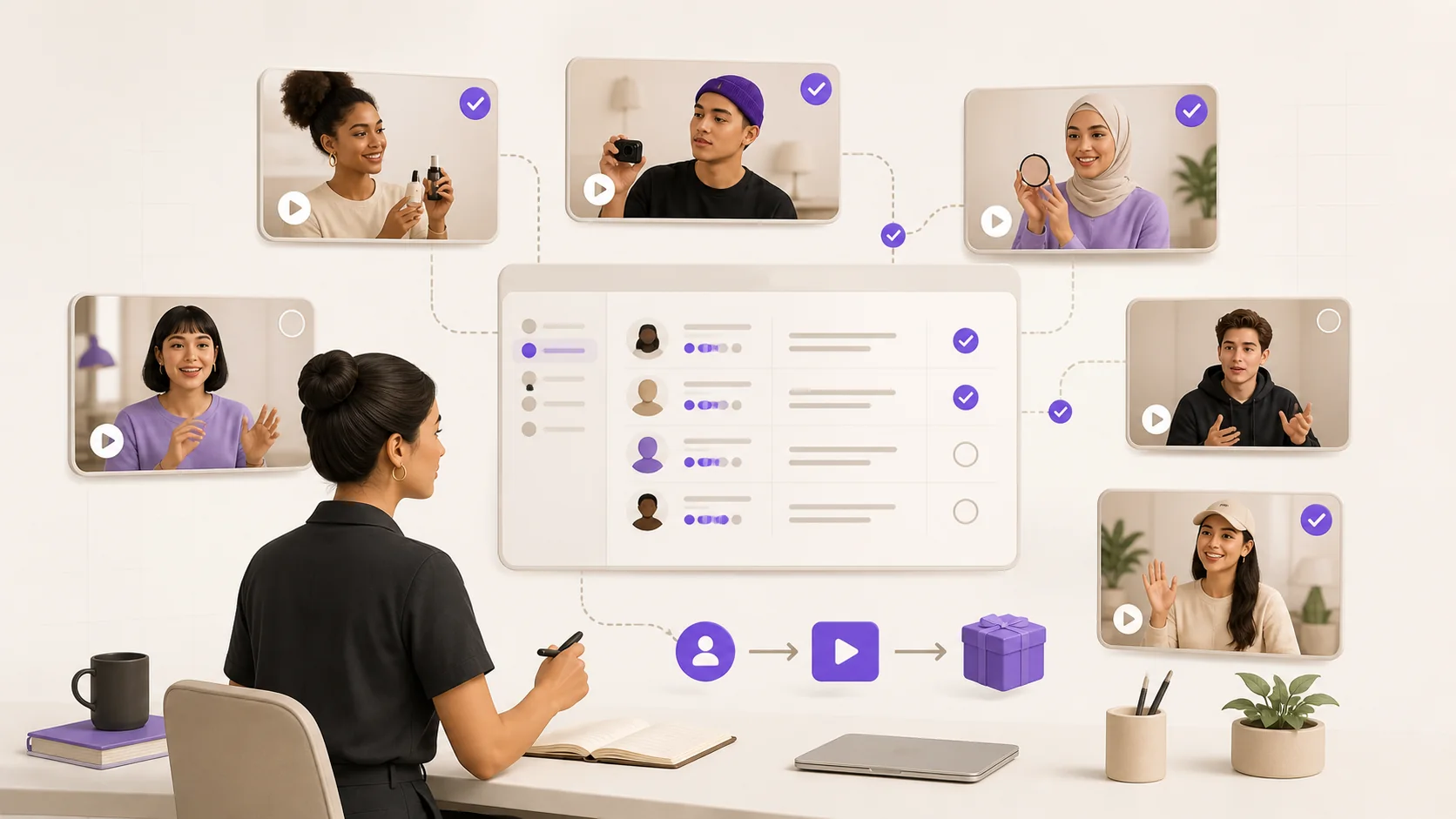
Short answer: Find UGC creators by defining the content job first, recruiting through two or three channels, screening for content fit rather than follower count, and paying a small cohort to complete the same test brief. Keep the creators who follow the brief, communicate reliably, and produce usable variations—then connect them to one campaign, approval, reporting, and payout workflow.
What UGC creator sourcing actually includes
UGC creator sourcing is the process of finding, evaluating, contracting, and onboarding people who can make brand-ready short-form content. It is not the same as buying reach from an influencer. A UGC creator can be valuable without a large audience because the brand is hiring the creator's production skill, point of view, and ability to deliver against a brief.
The sourcing job therefore ends later than “we found a profile.” A creator is not truly sourced until the team knows what they can make, what rights are included, how they communicate, where their deliverables live, and how they will be paid.
Start with a sourcing brief, not a search bar
Teams waste the most time when they browse creators before agreeing on the job. Write a one-page sourcing brief with the constraints below before opening a marketplace, TikTok, a spreadsheet, or a creator database.
- Audience fit: the customer identity, geography, language, age range, and lived experience the content must represent.
- Content job: product demo, problem-solution story, testimonial, tutorial, reaction, comparison, founder-style explanation, or another defined format.
- Distribution: the creator's account, a brand-owned account, organic social, paid ads, landing pages, app-store pages, or email.
- Deliverables: aspect ratio, length, raw footage, hooks, cutdowns, captions, thumbnails, and revision allowance.
- Rights: channels, usage period, paid-media rights, editing rights, exclusivity, and renewal terms.
- Operating constraints: deadline, product shipping, required disclosures, prohibited claims, approval owner, and budget.
This brief creates a fair filter. Without it, teams tend to select the most polished portfolio instead of the creator most likely to solve the campaign's actual problem.
Where brands can find UGC creators
| Channel | Best for | Main tradeoff | What to verify |
|---|---|---|---|
| Opted-in marketplace | Fast inbound applications and repeatable volume | Supply quality varies by niche and region | Recent activity, examples, rights, and platform fees |
| Past creator roster | Reliable repeat work and faster onboarding | The pool can become visually repetitive | Recent performance, availability, and creative fatigue |
| TikTok, Instagram, and YouTube search | Finding native styles and emerging voices | Manual review and outreach take time | Original work, contact path, brand safety, and consistency |
| Creator communities and referrals | Niche fit and trusted introductions | Profiles and rates are less standardized | Portfolio ownership, reliability, and payment expectations |
| Managed sourcing partner | Teams that need a shortlist and operating help | Higher service cost and less direct control | Screening method, replacement policy, rights, and data handoff |
Use more than one channel. A marketplace can generate volume while direct search supplies niche styles, and a retained roster gives the campaign a reliable baseline. The mix reduces dependence on any single source.
Choose a UGC creator sourcing model
There is no single best UGC creator sourcing channel. Choose the model that matches your required volume, niche specificity, internal review capacity, and need for creator-posted distribution.
| Sourcing model | Best for | Cost pattern | What to verify |
|---|---|---|---|
| Direct social search | Specific native styles and small shortlists | Low tool cost; high internal time | Original work, contact details, availability, and response rate |
| Opted-in creator marketplace | Fast applications and repeatable campaign volume | Subscription, take rate, or campaign fee | Recent creator activity, category supply, fees, and usage-rights handling |
| Influencer database | Audience-led discovery and creator-posted reach | Software subscription | Data freshness, opt-in status, audience authenticity, and outreach limits |
| UGC agency or managed partner | High-volume programs without added internal headcount | Project fee or retainer | Screening method, replacement policy, creative ownership, and reporting handoff |
| Customers and referrals | Authentic product experience and niche credibility | Product, incentive, or creator fee | Consent, commercial rights, disclosure, and production reliability |
Compare software options in the micro influencer platform guide, then use the UGC creator onboarding checklist once a creator passes the paid test.
A 30-day UGC creator sourcing cadence
- Week 1: define the audience, content job, deliverables, rights, budget, and written scoring rubric.
- Week 2: recruit through two or three channels, record the source of every candidate, and shortlist against non-negotiable criteria.
- Week 3: pay a small cohort to complete the same test brief and score both the content and the working process.
- Week 4: onboard the strongest creators, record their demonstrated roles, and carry contracts, approvals, posts, reporting, and payout state into one operating record.
How to vet UGC creators with a consistent scorecard
Follower count is useful only when the campaign is buying distribution. For content production, score evidence that predicts whether the creator will deliver useful work. Apply the same rubric to every shortlisted creator so the loudest portfolio does not win by default.
| Criterion | Weight | Evidence to review |
|---|---|---|
| Content and audience fit | 25% | Natural voice, setting, category credibility, and customer resemblance |
| Hook and storytelling skill | 20% | First three seconds, clarity, pacing, demonstrations, and calls to action |
| Brief adherence | 20% | Required claims, shot list, format, duration, and submitted variations |
| Reliability | 15% | Response time, questions asked, deadline history, and file organization |
| Technical baseline | 10% | Clean audio, usable light, stable framing, and editable source files |
| Compliance and rights readiness | 10% | Disclosure awareness, claim discipline, identity verification, and contract acceptance |
Keep written notes beside each score. A number without evidence becomes another opinion. If two reviewers score creators, calibrate the first five profiles together before splitting the work.
Run a paid test before you scale a creator
Portfolios show selected wins. A paid test shows how the creator handles your product, your constraints, and your team. Give a small cohort the same compact brief so the result is comparable.
- Recruit broadly. Build a pool large enough to preserve variety in creator identity, delivery style, and concept.
- Shortlist against the scorecard. Remove profiles that miss non-negotiable audience, rights, or availability requirements.
- Pay for a bounded trial. Request one concept with defined variations, one deadline, and one revision round. Do not ask creators to perform speculative work for free.
- Review the process and the asset. Record communication, questions, timeliness, file hygiene, brief adherence, and the quality of the final content.
- Retain by role. Label the creator by demonstrated strength—tutorials, reactions, testimonials, paid-ad hooks, organic posting, or another useful role.
A simple planning example is a 20 → 8 → 4 funnel: source twenty relevant profiles, invite eight to a structured conversation or application, and pay four to complete a small trial. Those figures are not an industry benchmark; adjust the funnel to your category, budget, and deadline. The principle is to compare several creators under the same conditions before committing volume.
Separate content fit from distribution fit
A creator can be excellent on camera and still have no relevant audience. Another can have strong distribution but produce footage the brand cannot reuse. Decide which value you are buying:
- Content-only UGC: prioritize creative skill, customer resemblance, reliability, rights, and production fit.
- Creator-posted content: add audience geography, engagement quality, category relevance, disclosure history, and posting consistency.
- Paid partnership or whitelisting: add account eligibility, authorization period, ad access, usage rights, and a clear renewal process.
Do not use one blended “creator quality” score for all three jobs. It hides the reason a person is valuable and makes later performance analysis less useful.
Move every approved creator into an operating record
Sourcing produces a shortlist; operations turn that shortlist into published work. For each approved creator, keep the following attached to one durable record:
- contact details, social accounts, region, languages, category, and content strengths;
- contract status, usage rights, rates, payout readiness, and tax information;
- campaign assignment, current brief, deliverables, feedback, and approval history;
- live post URLs, platform metrics, bonuses, payout status, and performance notes;
- duplicate checks and relationship history so the same person is not onboarded twice.
This is where creator sourcing usually breaks. The shortlist lives in one sheet, the brief in a document, approvals in direct messages, metrics in platform tabs, and payouts in finance. The handoff erases context and forces the team to rebuild the same record at every stage.
Build compliance into the brief and review
Creators and brands should treat disclosure and claim review as part of production, not as a caption added after approval. The U.S. Federal Trade Commission says material connections to a brand should be disclosed clearly and in a place people will notice. For video endorsements, the FTC advises putting the disclosure in the video rather than relying only on the description. Read the FTC's current Disclosures 101 guidance and its broader endorsements and reviews resources, then have counsel adapt requirements to your market and campaign.
Put required disclosure language, claim substantiation, prohibited claims, music rules, competitor references, and approval steps inside the creator brief. Review the final exported asset—not only the script—because edits can change whether a disclosure remains clear.
Common creator-sourcing mistakes
- Searching before defining the job. The team collects attractive profiles that do not fit one comparable brief.
- Optimizing for follower count. Distribution metrics replace production evidence even when the brand only needs assets.
- Using one creator as the whole test. One result cannot separate the concept, the creator, and normal performance variance.
- Leaving rights until delivery. The team discovers too late that paid usage, raw footage, edits, or renewals were not included.
- Handing off a spreadsheet. Sourcing data is detached from the campaign, approvals, live posts, and payouts that reveal whether the match worked.
- Keeping no rejection reason. The next sourcing cycle repeats the same review because the team did not record why profiles failed.
How UGC Infra supports the workflow after sourcing
UGC Infra is the operating layer for teams that have selected creators and need to run the work without reconstructing it across tabs. Creator DB keeps onboarding, social accounts, duplicate checks, contracts, deliverables, and payout readiness attached to each creator. Campaign OS connects those records to briefs, submissions, revisions, approvals, and live posts. Reporting then ties campaign and creator performance back to the same record, while payout history preserves how the work was settled.
If your team also needs hands-on creator sourcing, UGC Infra is built by Adworkly, which can support managed sourcing and high-volume UGC programs. See how Creator DB works, or compare platform plans.
Frequently asked questions
What is the best way to find UGC creators?
The best method depends on volume and niche. Use an opted-in marketplace or inbound campaign for speed, direct social search for specific native styles, past creators for reliability, and managed sourcing when your team lacks review capacity. Most brands benefit from combining at least two channels.
How do you vet a UGC creator?
Review content fit, hook skill, brief adherence, reliability, technical quality, and compliance readiness using one written scorecard. Then pay a shortlist to complete the same small test brief before assigning ongoing volume.
Do UGC creators need many followers?
No, not when the brand is purchasing content for its own channels. Follower count matters when the campaign also pays for distribution on the creator's account. Keep content-production and distribution criteria separate.
What should happen after a creator is selected?
Move the creator into a durable operating record containing the contract, rights, rates, payout readiness, campaign assignments, deliverables, approvals, live posts, and performance history. This prevents the sourcing handoff from losing context.

